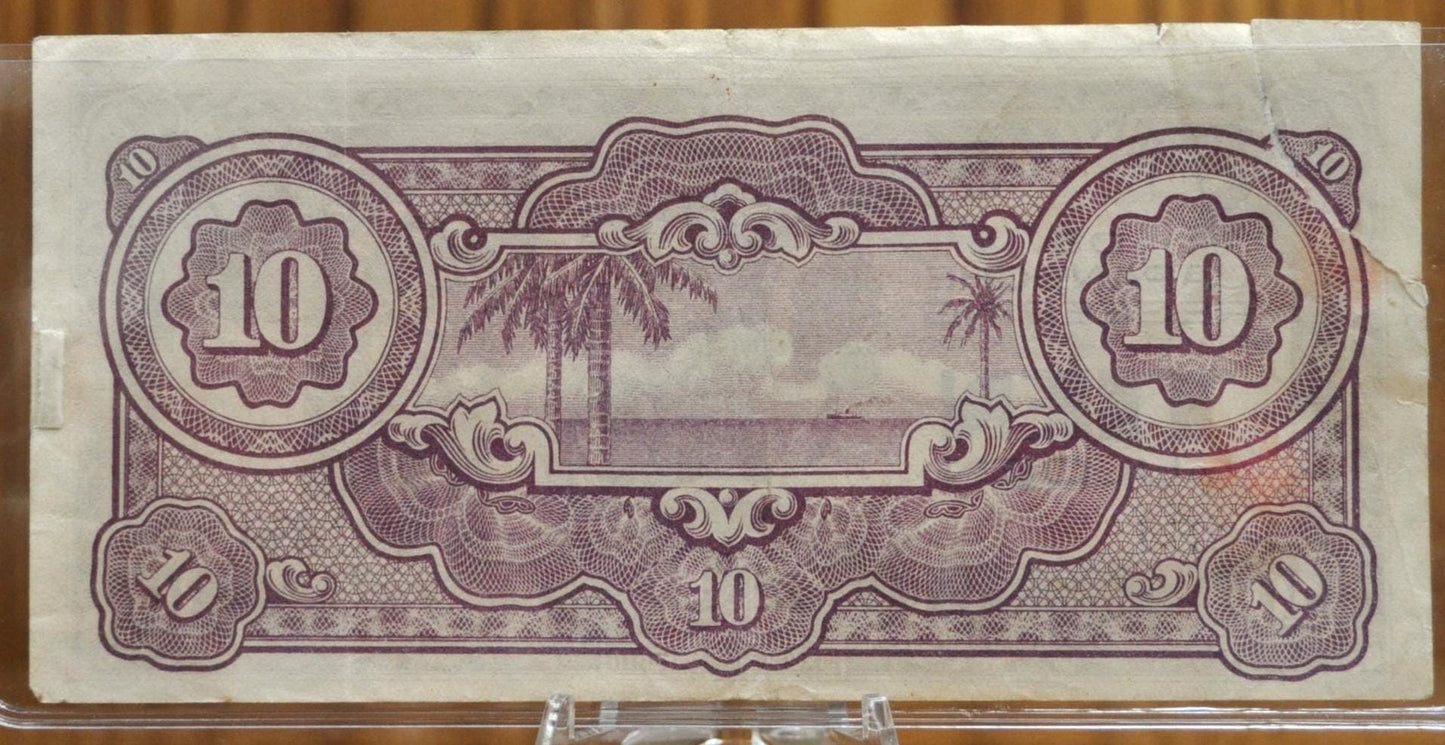


1942 Japanese East Indies Ten Gulden- Dutch East Indies WWII Occupation - Series SI - 1942 Japanese Government Indies 10 Gulden - P#125c
1942 Japanese East Indies Ten Gulden- Dutch East Indies WWII Occupation - Series SI - 1942 Japanese Government Indies 10 Gulden - P#125c
Couldn't load pickup availability
This listing is for the photographed 1942 Ten Gulden note issued by the Japanese government during their occupation of the Dutch West Indies. This issue has the prefix SI, differentiating it from other issues. Note is in great conditon with some minor discoloration and the upper left corner torn, as pictured. Great piece of history and an excellent addition to any collection! P#125c (Pick Number 125c).
In December 1941, the Empire of Japan began its assault on British Borneo; by January 1942 its armies had begun to attack those parts of the island which were part of the Dutch East Indies. This was followed by attacks on Sumatra and Java in February. Ultimately, the Dutch colonial government capitulated on 8 March 1942, though pockets of resistance lasted for several months. In the succeeding months, the Japanese government closed the banks, seized assets and currency, and assumed control of the Indies' economy.
Java was left under the administration of the Sixteenth Army, Sumatra under the Twenty-Fifth Army, and the remainder of the archipelago under the Japanese Navy. This administrative division meant that some notes were highly localized. For instance, the 100 and 1000 gulden notes, with a design similar to that used in occupied Malaya (also under the Twenty-Fifth Army), were only meant to be circulated in Sumatra. There is no evidence, however, that the latter were actually in use.
The Japanese occupation government immediately began issuing military banknotes for use in the occupied Indies, as had previously been done in other occupied territories. These first banknotes were printed in Japan, and issued by the Ministry of Finance. This issue formally retained the gulden name, though in common indigene parlance it was called oeang Djepang (Japanese money) or oeang pisang (banana money, for the prominent bananas on the ten gulden note). Each gulden (or, later, roepiah) consisted of 100 cents (sen).
Thanks for stopping by!
1942 Japanese East Indies Ten Gulden- Dutch East Indies WWII Occupation - Series SI - 1942 Japanese Government Indies 10 Gulden - P#125c